THE OBEYA WAY: CASCADING LEARNINGS WITH ANNELIES VAN DIJK
In the Obeya leadership, the power of bringing strategy, priorities, and conversations together in one place has already become clear. However, much of the value starts when others engage with the board and the content becomes transparent for everyone, operational teams and stakeholders alike. Some started to embrace this way of working, and from there, a natural follow-up began to emerge.
Getting through the first phase
To support onboarding teams into the Obeya way of working over time, Annelies van Dijk and Anton Flemminks-Smid, together with an Obeya coach, created an interactive workshop that fits the needs of the department. When a team shows interest, they start with three mornings of training. After that, we continue to support them for one or two quarters in refining the board and integrating the rituals.
The option to support a team for a few more months works really well for us. We notice that some teams are still searching in the beginning for the right level at which they want, and are able, to measure their progress. Defining indicators is often the most difficult part and simply takes a few Performance sessions. Usually, after one quarter, we see that things really start to land.
Getting through that first phase can be challenging.
In the beginning, it often feels like extra work rather than something that makes things easier. New meetings are introduced, while old habits are still there. Emails don’t suddenly stop, and conversations continue outside the Obeya board. For a while, everything exists next to each other.
Over time, a shift tends to happen. Sometimes old communication patterns gradually move into the new rituals, and it starts to feel like a more natural way of working. In other cases, teams find their own way of blending existing meetings with the new structure.
We try to follow what works best for the team to be successful.
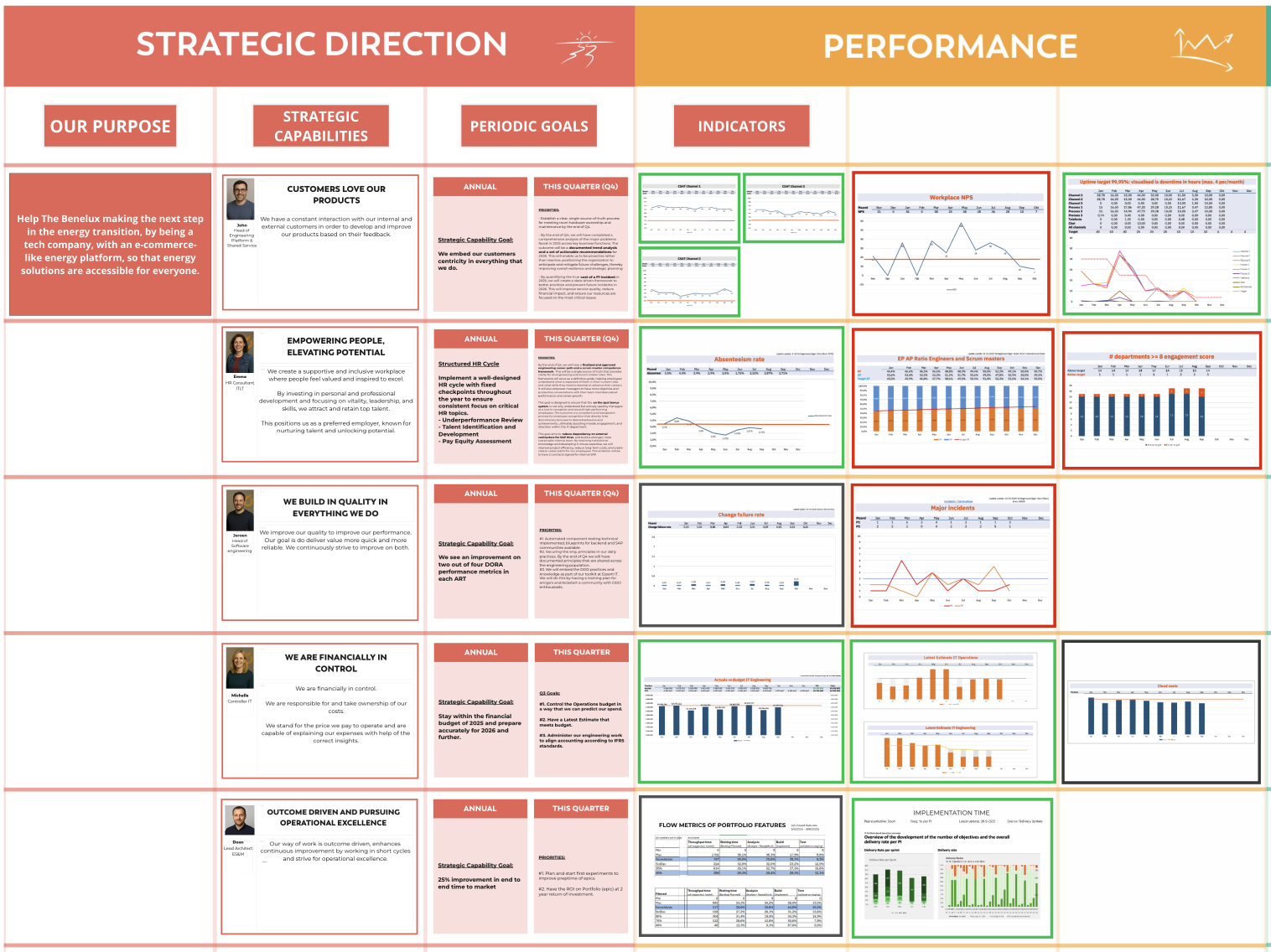
An example of what an Obeya board may look like
Cascading the boards
Within IT, we are aligned around our “triangle” of Engineering, Product, and Architecture across all levels. Naturally, these perspectives showed up in the boards as well.
At the same time, we also saw boards emerge that were more centered around a single discipline, more like a chapter or community board.
That isn’t necessarily a problem, but we learned that it does require a bit more attention to make clear what the board is meant to support, and how it connects back to the bigger picture.
At the same time, we are currently shifting the organization to a Journey model, which means that some of our existing boards will likely reorganize around the new departments. It really helps to already have a strong foundation. Conversations about how the new setup might (or might not) affect our targets, who will own them, and what would be the most logical way to rearrange things can all happen at an early stage, helping to manage expectations.
A shift in mindset
We started to notice that the real learning wasn’t in setting up the board itself, but in how we used it. In how conversations are structured. In what you choose to make visible. In how you guide the discussion.
At some point, it started to feel less like implementing a tool, and more like learning something about leadership.
- How do we decide what really matters?
- What conversations are we actually trying to have?
- And are we really having them?
It helped that from the beginning, leadership opened their Obeya board to the wider organization. They actively share progress in leadership calls, all- staff meetings, and with stakeholders.
We also place all other boards in the same folder so everyone can easily find and view them. These are small things, but they contribute to transparency and encourage others to think along and provide feedback.
Simply put, when Obeya cascades down to the teams, it does more than organise information. It empowers colleagues to collaborate, contribute, and keep the strategy in mind while delivering value. And so, step by step, it becomes part of the culture.
Thank you for following our Obeya series! Please feel free to reach out to our leadership team for more information about Obeya.